
 Ómar Thor ÓmarssonUpdated
 How do I know what to fix on my B2B website for more leads?
A clear and modern way to understand what your website needs using data and suggested actions
TLDR
Most B2B teams know their website could perform better, but very few know exactly what to fix or where to start. Dashboards offer data but not direction, which leaves marketers stuck in guesswork. Suggested actions change that by translating behaviour patterns, performance signals and content gaps into clear, practical recommendations.
This gives marketers a precise roadmap for improving clarity, conversions and overall website performance without needing a full redesign.
Why fixing a B2B website feels like an impossible task
Every B2B marketer has had moments where they feel deeply aware that their website is not doing what it should. They know the homepage could be clearer. They suspect the product pages do not tell the story strongly enough. They notice that conversion rates seem lower than they should be. They have a gut feeling that buyers are slipping away somewhere in the journey. What they do not know is where to look, which assumptions are correct and which decisions will actually move the needle.
The challenge usually begins the moment they open their analytics tool. Instead of clarity, they are met with dozens of metrics that feel disconnected from the real questions they need answered. Traffic graphs rise and fall without explanation. Bounce rates fluctuate. Journeys break at unexpected moments. Some pages perform well for reasons no one fully understands while others show signs of friction that no one can quite diagnose.
This is where most teams lose momentum. They know the problems exist, but the data does not tell them which issues matter most. They end up debating copy, structure, design, navigation and content for weeks without a clear sense of priority. Every idea feels plausible but none feel certain. Without clear direction, optimisation becomes a guessing game.
Why dashboards fail to show you what actually matters
Most analytics platforms are built to show information, not interpretation. They provide endless charts and granular data, but they rarely tell you what any of it means. They leave it up to the marketer to identify connections, translate behaviour and spot the signals hidden inside the noise. That responsibility is unrealistic for most teams, especially those juggling campaigns, reporting, sales support and product launches.
Dashboards show how many people bounced. They do not tell you that the bounce happened because your value proposition was unclear. They show where people clicked. They do not explain why they hesitated for ten seconds before clicking. They show drop offs. They do not reveal that the missing context on that page prevented buyers from moving forward. They show a decline in conversions. They do not explain that slow page loading times quietly eroded your highest intent traffic.
The problem is not lack of data. It is lack of meaning. B2B teams do not need fifty charts. They need five answers. They need to know what is broken, why it is happening and how to fix it.
Why suggested actions finally solve this problem
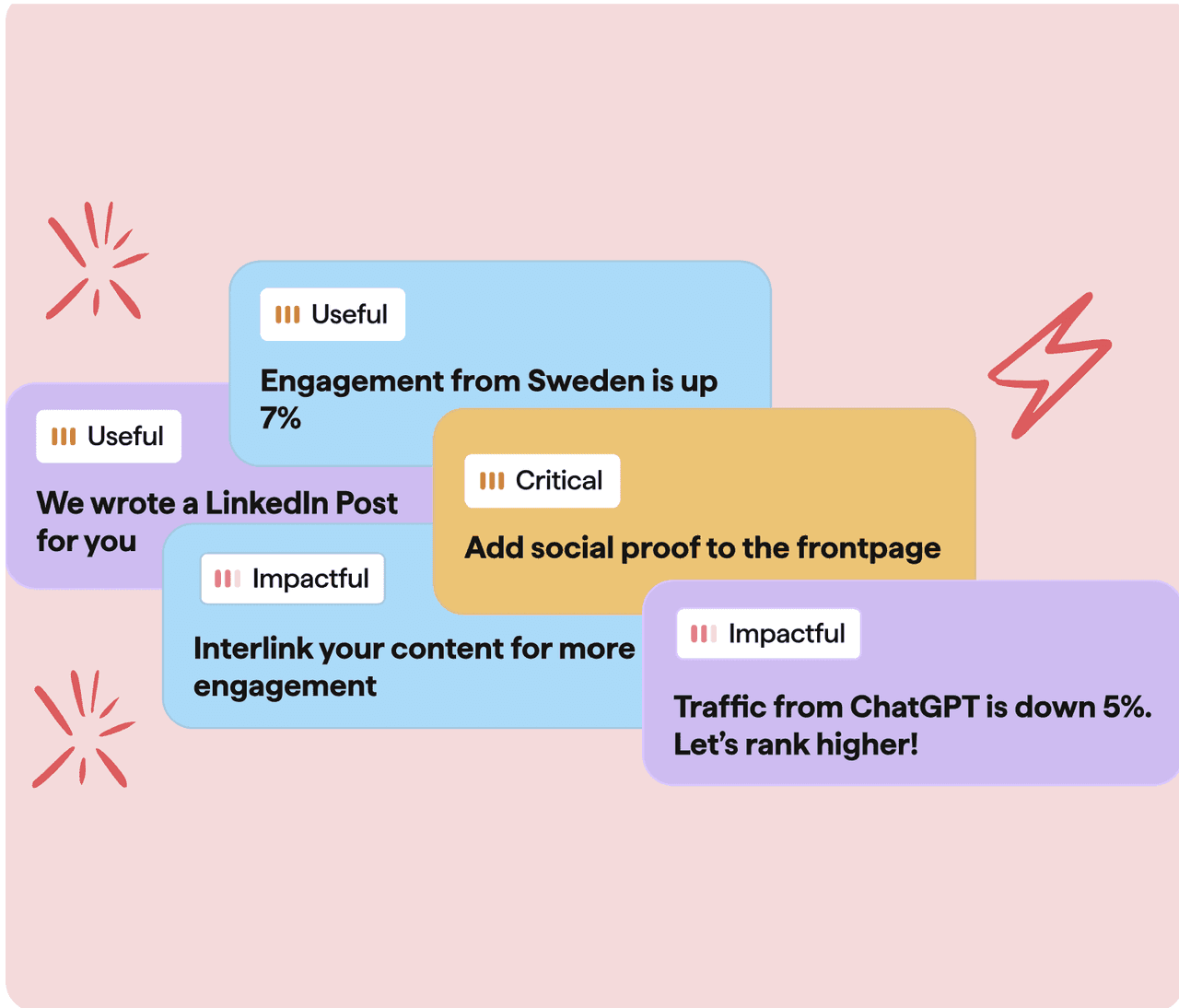
Suggested actions change the entire experience of understanding a website. Instead of requiring marketers to dig through dashboards and interpret complex behaviour, Optise does the heavy lifting in the background. It reviews the behaviour patterns across your website, the performance of key pages, the drop off points, the scroll depth, the engagement signals, the content gaps, the search intent mismatches and the overall journey flow. All of these signals come together to form a complete picture of what users are trying to do and where they are struggling.
From that analysis, Optise produces a list of recommended improvements that feel clear, practical and immediately useful. These recommendations are not vague suggestions. They are tied directly to specific behaviour and performance signals.
For example, when users consistently reach a section of your page and stop engaging, it is often a sign that the content is either unclear or insufficient. Suggested actions highlight this and tell you what needs refining. When buyers revisit the same product page multiple times without converting, it often signals missing information. Suggested actions point out the gap and recommend what content is missing.
Suggested actions feel different because they give you the feeling that someone finally walked through your website with you, highlighted the friction points and told you what to do next. They turn complex patterns into simple decisions. They create order out of chaos.
How data drives these recommendations
Behind every suggestion is a set of behaviour patterns that appear repeatedly across your website. These patterns are subtle but powerful. When scroll depth is high but conversions are low, it signals that buyers are engaged but uncertain. When traffic lands on a page but leaves within seconds, it signals misaligned expectations or unclear messaging. When your highest intent pages load slowly, it directly affects conversions.
When users behave differently across regions, campaigns or channels, it points to specific weaknesses in targeting or relevance.
Suggested actions interpret these patterns for you. They recognise what each behaviour means, why it matters and what the most effective response should be. They combine your analytics with industry benchmarks, best practices and your category’s behaviour trends to ensure that every recommendation feels grounded and relevant.
This level of interpretation used to require a team of analysts, hours of investigation and internal debates. Now it happens automatically and continuously. Your website is always being evaluated, and the most important signals are turned into the kind of guidance that is easy to understand and even easier to act on.
Why this matters for B2B teams
B2B websites are notoriously complex. They serve multiple personas, long buying cycles and high stakes decisions. Every page must balance education, clarity, reassurance and persuasion. When something is off, buyers rarely tell you. They simply leave.
This is why suggested actions are so valuable. They help you see your website through the lens of actual behaviour rather than assumptions. They remove the ambiguity that slows teams down and replace it with practical direction that moves websites forward without requiring a full rebuild.
For small teams, suggested actions save enormous time. Instead of digging through endless reports, they receive a list of improvements that are easy to prioritise. For larger teams, they create alignment. Everyone sees the same issues and works from the same source of truth. For leadership, they offer confidence. Performance issues become visible, understandable and measurable.
The end result is a website that improves steadily rather than sporadically. Optimisation becomes part of the weekly rhythm, not an occasional project. And growth becomes predictable rather than accidental.
Conclusion
Understanding what to fix on your B2B website should not require hours of detective work or guessing. Suggested actions provide a modern, data driven path forward by translating behaviour into clarity and clarity into action. They show you what matters, why it matters and how to fix it.
When teams follow these recommendations, their website becomes easier to understand, easier to navigate and far more effective at guiding buyers through the journey.
If you want to know what your website needs most right now, get your free website insight inside Optise.
FAQ
How do I know what to fix on my B2B website
Use suggested actions that analyse behaviour, performance signals and structural gaps to highlight what matters most.
Why are dashboards not enough
Dashboards show data, but they do not interpret it or tell you what to do next.
What makes suggested actions reliable
They are based on real behaviour patterns, performance metrics, benchmarks and industry best practices.
Do suggested actions reduce the need for a redesign
Often yes. Most websites do not need rebuilding, they need targeted improvements in the right areas.
Can suggested actions improve conversions
Yes. They identify the exact moments where buyers lose confidence and provide ways to fix them.
How often are suggested actions updated
Continuously. They adjust as your website traffic and behaviour change.
Do small teams benefit from this
Absolutely. Suggested actions save time, reduce complexity and help teams move faster.
Can this help with ranking on Google and AI engines
Yes. Suggested actions uncover missing content, unclear messaging and structural weaknesses that affect visibility.
Do I need to be an analytics expert
No. Suggested actions explain everything in clear language.
What is the first step to getting my own suggested actions
Sign up for a free website insight inside Optise and your recommendations will be generated automatically.
Ómar Thor Ómarsson
CEO & Co-founder