
How often should you update your website?
A high-performing B2B website should improve every week: content, fixes, and conversion updates continuously, with bigger structural reviews quarterly. In practice, a quarter of business websites go more than a year untouched, which is why "more often than you currently do" is the honest answer for most companies.
No credit card · Try in minutes
Last updated September 30, 2026
The question sounds like housekeeping. It's actually strategy. Update frequency decides whether your website compounds or decays: search engines reward freshness, AI engines weight recency when choosing sources, and buyers notice a site that describes last year's company. Here's the cadence that works, and the honest reason most companies can't keep it.
The cadence
Weekly: the improvements that compound
Content tuned to what buyers are searching now, fixes to underperforming pages, sharper CTAs, technical corrections, freshness signals. Small, continuous changes beat big rare ones twice over: engines see a living site, and each change teaches you what works. This cadence is what separates websites that grow from websites that exist.
Monthly: the visible additions
A new page or resource, updated proof (customers, numbers, milestones), and a review of what the data says about where visitors stall. If your company shipped something this month, the website should say so this month.
Quarterly: the structural look
Positioning check (does the site still describe the company?), page architecture against how buyers search, comparison content against competitor changes, and dates refreshed everywhere they appear. This is also the cadence on which stale sites quietly slip: skip two quarters and the drift becomes visible.
What the data says happens instead
The average business website gets significant updates far more rarely: a quarter of business websites are updated less than once a year (Network Solutions, 2026), and the typical site lives about two and a half years between rebuilds (Orbit Media). The gap between the right cadence and the real one isn't laziness. Nobody was hired to do this, and it loses to every deadline (why nobody improves the website).
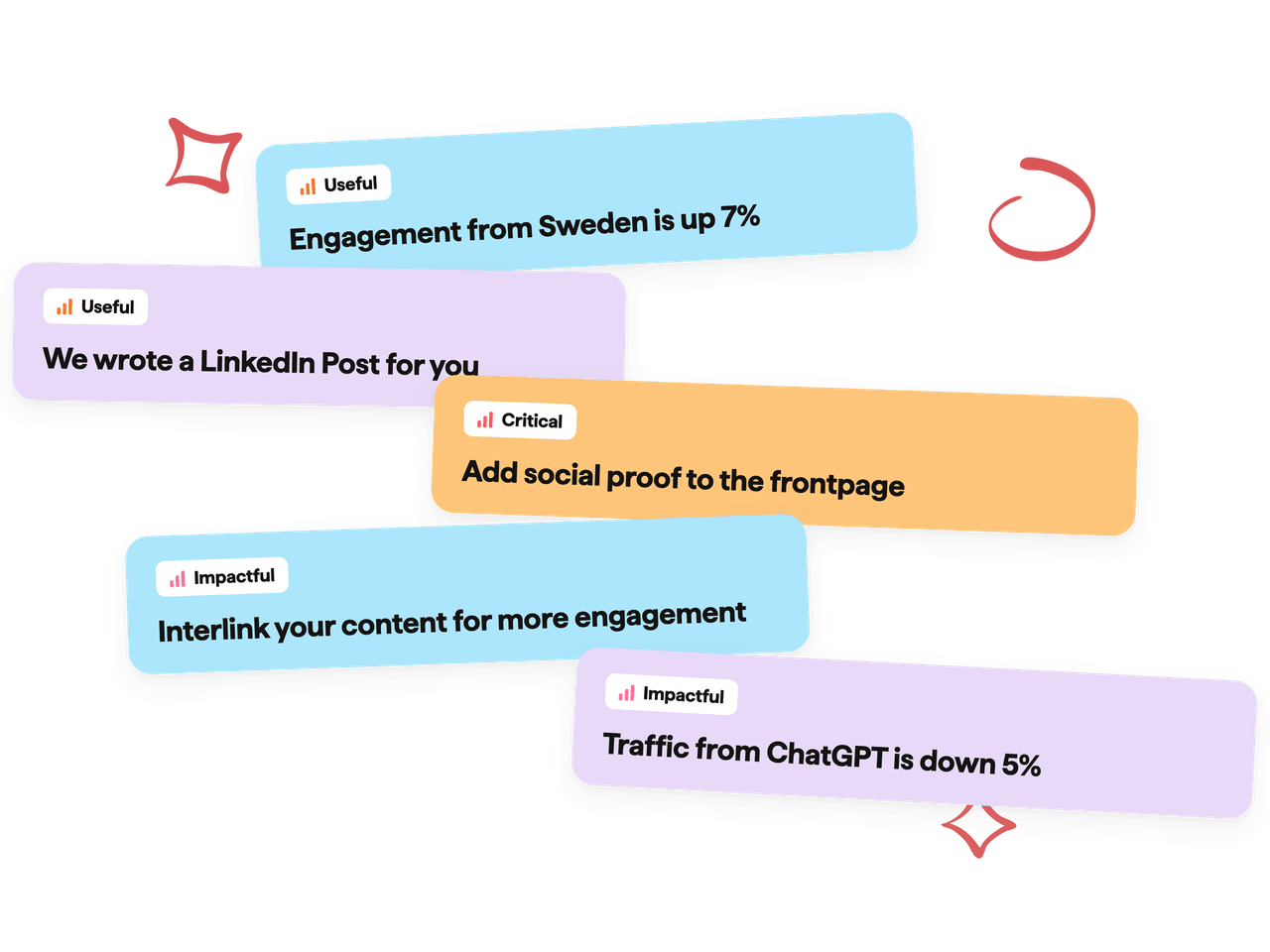
The cadence problem is a staffing problem, until it isn't
Weekly improvement is roughly a job. That's the real reason most websites don't get it: the choice has been "hire for it, retain an agency for it, or skip it," and most companies rationally skip it, then pay in leads.
The self-improving website exists to break that trade-off. The platform holds the weekly cadence itself: it measures the site, decides what to improve, and ships the changes, every week, with your approval on each one. The right update frequency stops being a discipline problem, because it's the product. Optise customers average 3x organic traffic growth and 4x inbound lead growth on exactly that rhythm.
Free to start. No credit card. Try in minutes.
Frequently asked questions
Yes, when the updates are real. Search engines and AI engines both favour fresh, current sources, and regularly improved pages accumulate rankings that static pages lose. Cosmetic re-saves don't count; improved answers, new proof, and fixed weak pages do.
Nothing dramatic, which is the problem. Rankings drift down, AI engines stop citing you, the copy slowly stops matching your company, and conversions decay a little each quarter. The cost is invisible until you compare it against a competitor who kept improving.
Start where money leaks: the homepage message (does it describe today's company?), your highest-traffic pages' answers and CTAs, and your proof (dates, customers, numbers). Then fix the real issue, deciding who improves the site every week from now on, or the staleness returns within a quarter.
Someone, permanently, is the only wrong-proof answer: a hired owner, a retained team, or a platform. Doing it properly in-house costs a $90,000-plus salary; a self-improving platform like Optise holds the weekly cadence for a fraction of that, with you approving every change.